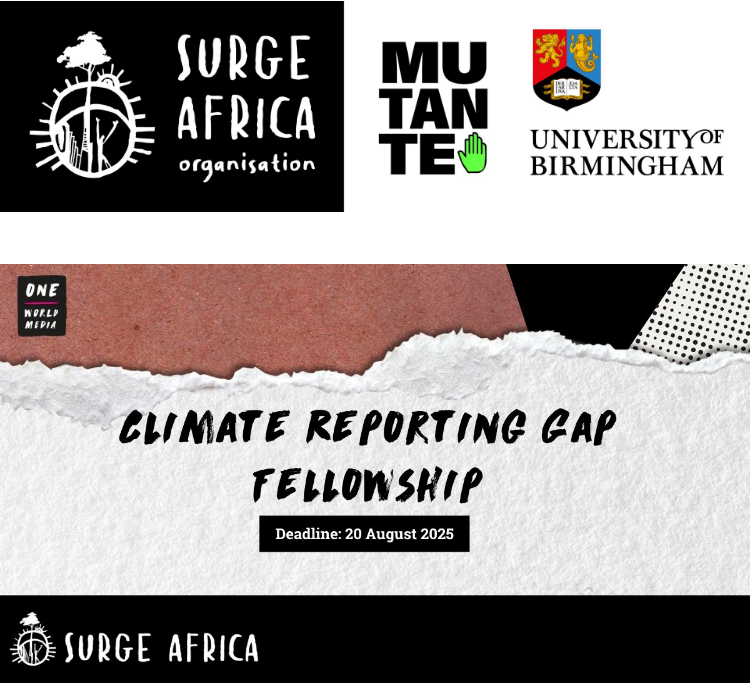
Entries open for the One World Media Climate Reporting Gap Fellowship
Entries are open for the One World Media Climate Reporting Gap Fellowship. Surge Africa and One World Media announce a new Fellowship focused on climate and energy transition reporting in Nigeria, established through their partnership. One World Media, in partnership with Surge Africa, is pleased to announce a new opportunity for Nigerian journalists as part of The Climate Reporting Gap Initiative. This Fellowship seeks journalists dedicated to making complex climate issues accessible and relevant to their communities.
Nigeria faces increasing impacts from climate change, including rising heat, water scarcity, and the complexities of the energy transition. Despite these challenges, local narratives connecting these issues to daily life are frequently underreported. The Climate Reporting Gap Fellowship aims to address this reporting gap.
This initiative will provide support to six Nigerian journalists for reporting original stories on climate finance and energy transition. The Fellowship encourages inclusive, data-driven, and community-centred approaches across various media formats, including print, audio, video, and multimedia. The program is designed to empower journalists to produce compelling, solutions-focused reporting with local and regional impact.
Selected projects will be awarded funding of £3,000 to £5,000, alongside one-to-one mentoring. The Fellowship provides comprehensive training and support to guide projects editorially and practically. All supported projects must be completed by June 2026.
This program is part of The Climate Reporting Gap Initiative, a collaboration involving Surge Africa, One World Media, Mutante, and the University of Birmingham.
**Call for Proposals: Journalism and Filmmaking Fellowship on Climate Change and Energy Transition in Nigeria**
**Focus Areas** – One World Media Climate Reporting Gap Fellowship
We invite proposals for investigative and impactful stories focusing on climate change and energy transition within Nigeria and the broader region.
Key areas of interest include:
* Transition minerals and their extraction
* Energy access and diplomacy
* Economic implications of phasing out fossil fuels
* Governance frameworks for transition minerals
* Decentralization of energy systems
* Strategies for eradicating energy poverty
* Development of enabling structures for a successful transition
Proposals should demonstrate a commitment to accountability, credibility, and urgency in reporting. Projects are expected to examine the economic landscape through the lens of these critical issues and contribute to building structures that facilitate the transition.
Proposals should align with the following objectives:
* **Grounding in Reality:** For fossil fuel-dependent economies like Nigeria, a significant portion of the population may perceive a thriving economy as impossible without oil. We aim to challenge this perception. Projects should foster constructive awareness of the climate crisis by amplifying grassroots perspectives, uncovering the true costs of the transition, and examining their intersection with social and economic dynamics.
* **Data-Driven Reporting:** We seek rigorous reporting that utilizes data as evidence to support arguments, incorporating climate science, case studies, and real-life experiences from Nigeria and beyond.
* **Highlighting Challenges and Solutions:** We encourage journalism that places local struggles at the forefront of climate discourse. This approach facilitates the emergence of local solutions and ensures that community demands and calls to action receive prominent attention.
* **Promoting Political Accountability:** We seek reporting that scrutinizes governmental actions at all levels to ensure that policy commitments translate into tangible outcomes. By unpacking the complexities of climate finance diplomacy and uncovering the political dimensions of energy transition, such reporting should foster urgency and emphasize the necessity of transparency.
**Eligibility** – One World Media Climate Reporting Gap Fellowship
- This opportunity is open to journalists and filmmakers who are Nigerian nationals and are reporting within Nigeria.
- Applicants should be mid-career or experienced professionals with a minimum of 3-5 years of experience in their respective fields.
- While a specific background in climate finance is not mandatory, applicants must demonstrate a strong interest in covering climate change and energy transitions, coupled with a robust background in journalism and/or their chosen medium.
- We particularly welcome innovative proposals that address underreported issues or feature perspectives from often-marginalized communities, offering unique or rare access.
**Fellowship Benefits** – One World Media Climate Reporting Gap Fellowship
Selected Fellows will receive:
* Funding support of up to £5,000 for their reporting project
* Dedicated one-to-one mentorship
* Comprehensive training, delivered both in-person and online
* Industry-specific workshops covering areas such as safety, impact, and pitching
* An international training opportunity in Colombia, South America
* Global dissemination of completed media pieces by project partners
* Membership in the OWM global alumni network
**Programme Structure** – One World Media Climate Reporting Gap Fellowship
- The Fellowship provides in-depth training and mentorship designed to offer comprehensive editorial and practical guidance throughout the project lifecycle. Fellows will participate in an initial in-person training session in Nigeria, engage in online workshops throughout the programme duration, and undertake a training trip to Colombia for specialized training on participatory reporting facilitated by our partner organization, Mutante.
- Each project will be assigned a dedicated mentor. Fellows are required to participate in regular check-ins to track progress towards agreed delivery milestones.
- Project grants will range between £3,000 and £5,000, disbursed in instalments according to a predetermined schedule.
- Final outputs can be submitted in any format, including text, video, or audio. We are receptive to well-developed proposals employing creative multimedia approaches. The use of data visualization, illustration, animation, interactive, and alternative formats is encouraged.
- Proposed articles should not exceed 2,000 words, audio pieces should be a maximum of 30 minutes in duration, and films should be no longer than 10 minutes.
- All projects must be completed by June 2026.
**Rationale** – One World Media Climate Reporting Gap Fellowship
- The Fellowship aims to enhance the knowledge and skills of journalists in effectively reporting and communicating stories related to climate change and the politics of energy transition.
- Journalists possess a unique capacity to shape narratives by focusing on local contexts informed by a global perspective, drawing connections, and fostering new understanding regarding climate change issues.
The core principles underpinning this initiative are:
* **Prioritizing Energy Transition Politics:** The Fellowship emphasizes stories centered on energy transition. This includes examining the economic landscape from perspectives such as decentralizing energy systems, eradicating energy poverty, accelerating the phase-out of fossil fuels, governing transition minerals, and developing structures to facilitate the transition.
* **Analyzing Transition Finance Diplomacy:** Recent years have seen diplomacy play a crucial role in facilitating access to large-scale climate finance. However, many declarations are not followed by concrete actions, or the terms are not favorable to recipient nations, issues that often remain underreported. We require reporting that conveys the urgency of securing financial resources for the transition and highlights the critical roles of transparency and accountability.
* **Localizing Climate Data and Narratives:** While climate data is widely available, there is a notable gap in tailored content that effectively engages specific audiences, particularly those directly impacted by climate change. We need more accessible media content and public campaigns where language and messaging resonate locally.
* **Expanding Research on Transition Narratives:** A just societal transformation necessitates the inclusion of all stakeholders’ voices and a broad understanding and discussion of changes across diverse groups, including marginalized communities often excluded from public debate and decision-making.
* **Centering Local Voices and Agency:** We are keen to explore the contributions of local communities amidst social, economic, and political flux, and how active citizen participation can ground locally-derived solutions for new energy systems. Such reporting will amplify community demands and underscore the importance of participation in governance to scale solutions and interventions.
Application – One World Media Climate Reporting Gap Fellowship
- For details and to apply visit the official website
- Deadline: August 20, 2025